What Is Artificial Intelligence? 10 Real-World Engineering Examples Explained

A Software Engineer's Perspective: Cutting Through the Hype
Most introductory guides define Artificial Intelligence with vague philosophical soundbites: "machines that mimic human cognitive functions." While poetically accurate, that definition is useless for developers, system architects, and technical decision-makers.
From a software engineering perspective:
Traditional Software is Deterministic: You write explicit logic (if/else, loops, relational queries), feed it data, and get an exact calculated output.
Artificial Intelligence is Probabilistic & Inductive: You feed a model input data and desired outputs, and an optimization algorithm learns the mathematical function parameters (weights & biases) that best map the relationship.
In this comprehensive guide, we unpack the foundational continuum of AI, debunk common misconceptions, and walk through 10 concrete, production-grade engineering examples powering the modern digital economy.
The Concentric Hierarchy of AI
How Artificial Intelligence, Machine Learning, Deep Learning, and Generative AI interconnect
The broad domain of computational systems designed to solve complex heuristics, logic trees, or statistical goals.
A* Search, Expert Systems, Game TreesStatistical algorithms that extract patterns from tabular, time-series, or labeled datasets without hardcoded logic.
XGBoost, Random Forests, SVMsMulti-layer artificial neural networks trained on unstructured perceptual data like raw audio, video, pixels, and text.
CNNs, RNNs, Transformers, Diffusion10 Real-World Engineering Examples Explained
1. Retrieval-Augmented Generation (RAG) & Enterprise Search
NLP • Vector EmbeddingsThe Problem: Traditional database search relies on exact keyword matching. If a user queries "How do I expense a home monitor?", SQL LIKE statements fail if the HR policy document only uses the term "office peripherals reimbursement".
The AI Solution: A dense embedding model (e.g., Google’s gemini-embedding-001) converts text chunks into 768-dimensional mathematical coordinates. Because "monitor" and "peripherals" occupy nearby geometric coordinates in vector space, Cosine Similarity search instantly locates the document chunk and hands it to an LLM to synthesize a grounded answer.
2. Streaming Recommendation Systems (Spotify, Netflix & YouTube)
Collaborative Filtering • Two-Tower NetsThe Problem: When a user logs into Netflix or Spotify, the platform must select 20 personalized recommendations from an active catalog of over 100 million tracks or videos in under 50 milliseconds.
The AI Solution: Modern recommendation architectures use Two-Tower Neural Networks. One tower computes real-time embeddings for the user (listening history, device, time of day), while the second tower pre-computes item embeddings. Approximate Nearest Neighbor (ANN) search computes dot products in milliseconds to generate the personalized homepage feed.
3. Autonomous Vehicle Perception & Sensor Fusion (Tesla, Waymo)
Computer Vision • Sensor FusionThe Problem: An autonomous car cruising at 60 mph (88 feet per second) must identify pedestrians, lane boundaries, traffic signs, and erratic drivers across rain, fog, and darkness with zero latency tolerance.
The AI Solution: Multi-camera streams and LiDAR pulses are fed into Bird’s-Eye-View (BEV) Transformers. The neural network merges raw 2D pixel streams from 8 distinct camera angles into a unified 3D vector space, predicting obstacle depth, trajectory velocities, and occlusion maps in real-time edge hardware.
4. AI Code Completion & Synthesis (GitHub Copilot, Cursor)
Autoregressive Transformers • AST ParsingThe Problem: Legacy IDE autocomplete only suggested method names already imported in scope. Developers still spent 40% of their day writing boilerplate tests, CRUD endpoints, and regex transforms.
The AI Solution: Code models are trained on billions of lines of syntax trees and git repositories. By analyzing current cursor line position, file dependencies, and neighboring open tabs, the transformer performs next-token probability prediction to generate complete, syntactically valid functions in milliseconds.
5. Sub-50ms Credit Card Fraud Detection (Visa, Stripe)
Gradient Boosting • Anomaly DetectionThe Problem: Financial payment gateways process over 65,000 transactions per second. Every single card swipe must be assessed for stolen credentials before the point-of-sale terminal approves the charge.
The AI Solution: Rather than relying on simple static rules (e.g. "flag purchases over $1,000"), payment processors run high-throughput Gradient Boosted Decision Trees (XGBoost/LightGBM) and Autoencoders. They evaluate hundreds of real-time features—IP velocity, device fingerprint, geolocation jump speed, merchant category, time of day—returning a fraud probability score in under 30ms.
6. Medical Diagnostic Imaging & Oncology Detection
U-Net • Semantic SegmentationThe Problem: Radiologists review hundreds of high-resolution MRI, CT, and X-ray slices daily. Early-stage micro-tumors or hairline fractures can be missed due to eye fatigue.
The AI Solution: Deep learning architectures like U-Net perform pixel-level semantic segmentation. The model identifies anomalous cell densities, segmenting micro-calcifications in mammography or nodule boundaries in lung CT scans with greater than 96% sensitivity, providing instant diagnostic second opinions.
7. Automatic Speech Recognition (ASR) & Voice Synthesis (OpenAI Whisper, ElevenLabs)
Audio Transformers • Diffusion AudioThe Problem: Older speech-to-text systems choked on background noise, accents, fast speech cadence, and homophones (e.g. "there" vs "their").
The AI Solution: Modern models like Whisper convert raw audio waveforms into mel-spectrograms (2D visual acoustic frequency representations). An encoder-decoder transformer processes both acoustic frequencies and lexical language probabilities concurrently, enabling near-human transcription accuracy even in noisy restaurants.
8. Dynamic Pricing & Fleet Routing (Uber, Amazon Logistics)
Reinforcement Learning • Operations ResearchThe Problem: Dispatching thousands of delivery vans or ride-share drivers across a city during an unexpected monsoon storm requires solving NP-hard routing problems while dynamically adjusting surge fares to balance supply and demand.
The AI Solution: Platforms deploy Deep Reinforcement Learning (DRL) agents paired with Graph Neural Networks (GNNs). Agents receive continuous state vectors (traffic congestion, pending pickup requests, active drivers) and dynamically select optimal vehicle-to-passenger pairings to minimize wait times across the city grid.
9. Generative Diffusion Models (Midjourney, Flux, Stable Diffusion)
Latent Diffusion • Cross-AttentionThe Problem: Generating photorealistic imagery from natural language prompts requires synthesizing lighting, anatomical physics, reflections, and perspective from scratch.
The AI Solution: Latent Diffusion Models reverse entropy. The model is trained to iteratively predict and remove Gaussian noise added to training images. When conditioned on a text prompt via CLIP / T5 text encoders, the model steps backward through noise space, revealing a crisp, coherent 4K image guided by the prompt's cross-attention maps.
10. Industrial IoT Predictive Maintenance (Wind Turbines, Aviation)
Time-Series • LSTM / Temporal TransformersThe Problem: A commercial airliner engine failing mid-flight is catastrophic. However, replacing turbine components prematurely based on static calendar schedules wastes millions of dollars in operational expenditure.
The AI Solution: Thousands of vibration, temperature, oil pressure, and rotational sensors stream telemetry at 1,000 Hz into Temporal Fusion Transformers. The model detects subtle harmonic oscillations and microscopic thermal degradation weeks before human maintenance crews could ever hear or see mechanical wear.
Architecture Breakdown: Traditional Software vs. ML vs. Deep Learning
When deciding whether your next business feature actually requires AI, use this engineering framework:
| Dimension | Deterministic Code (C# / SQL) | Classical Machine Learning | Deep Learning & Foundation AI |
|---|---|---|---|
| How Logic is Formed | Explicitly programmed by human engineers | Statistical induction on structured tables | Learned representations on raw unstructured media |
| Ideal Input Data | Relational databases, JSON payloads | Tabular CSV, historical financial records | Raw images, continuous audio, human language |
| Explainability (Auditability) | 100% Deterministic (Traceable stack trace) | High (SHAP values, feature importance) | Low to Moderate (Black box weights) |
| Compute Requirement | Low (Standard CPU cores) | Moderate (Multi-core CPUs / Basic GPUs) | High to Massive (NVIDIA H100/H200, TPUs) |
| When to Choose | Business logic, billing calculators, user auth | Churn prediction, fraud risk scoring, sales forecasting | Chatbots, computer vision, code agents, search |
Frequently Asked Questions (FAQ)
What is the difference between AI, Machine Learning, and Deep Learning?
Think of them as Russian nesting dolls. Artificial Intelligence is the overarching field of creating machines that solve cognitive challenges. Machine Learning is a subset of AI that learns patterns from data rather than hardcoded rules. Deep Learning is a subset of Machine Learning that uses multi-layer neural networks capable of learning complex representations directly from raw perceptual data like images and text.
Does a system need neural networks to be considered Artificial Intelligence?
No. Classic AI systems included rule-based expert systems, the A* pathfinding algorithm in video games, and symbolic logic engines. However, modern commercial AI (2020s onwards) is overwhelmingly driven by statistical machine learning and deep neural networks because they scale effectively with massive compute and internet-scale datasets.
How can a traditional software engineer start working with AI today?
You don't need a Ph.D. in mathematics to build impactful AI systems today. Start at the application layer by building a Retrieval-Augmented Generation (RAG) application or an AI Assistant with Tool Calling using high-level frameworks like Microsoft Semantic Kernel in C# or LangChain in Python. As you progress, explore vector databases, fine-tuning, and open-weights model deployment.
 Tutorial
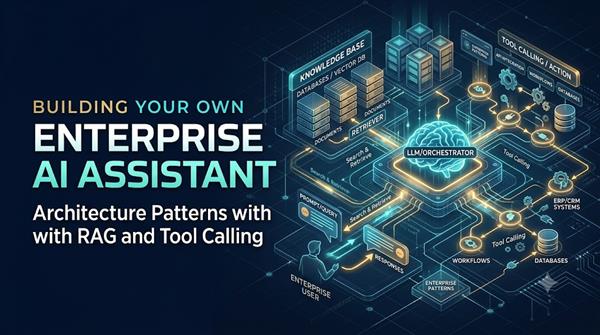
Building Your Own Enterprise AI Assistant: Architecture Patterns with RAG and Tool Calling
 Tutorial
Building an Enterprise RAG Application in C# with Google Gemini and SQL Server 2025 Vector Engine
 Tutorial
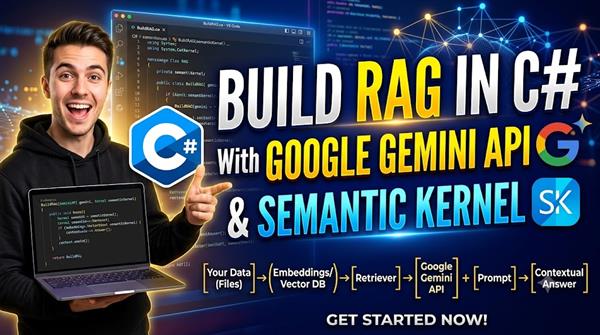
How to Build RAG in C# with Google Gemini API and Semantic Kernel
 Tutorial
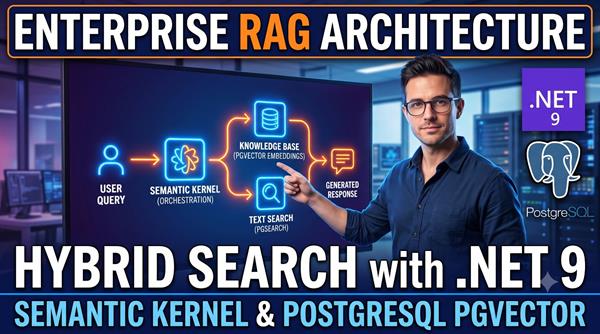
Enterprise RAG Architecture in .NET 9: Hybrid Search with Semantic Kernel and PostgreSQL pgvector
Comments

|
|
| Follow up comments |
| {{e.Name}} {{e.Comments}} |
{{e.days}} | |
|
|
||
|
|
||
| {{r.Name}} {{r.Comments}} |
{{r.days}} | |
|
|
||