
GPT-6 Astra Launched: Everything You Need to Know About OpenAI’s New AI Model

OpenAI has officially launched GPT-6 Astra, its newest and most capable artificial intelligence model, promising a major leap in reasoning, coding, computer use, research, cybersecurity, and professional work.
Unlike earlier generations that primarily focused on generating text and answering questions, GPT-6 Astra is designed to perform complete, multi-step tasks on a computer. OpenAI says the model can browse the web, interact with applications, create documents and spreadsheets, write and test software, conduct research, and adapt as users change their requirements.
The launch took place on September 3, 2026, with access initially limited to a small group of organizations before a broader rollout to ChatGPT paid plans and developers.
What Is GPT-6 Astra?
GPT-6 Astra is OpenAI's latest flagship AI model, built for what the company describes as hardest end-to-end work.
It combines advanced reasoning with computer-use capabilities, allowing the model to do more than produce an answer. Astra is designed to take an objective, break it into multiple steps, use available tools and software, and deliver a finished result.
OpenAI describes Astra as its “most intelligent and aligned” model and says it establishes new benchmarks across computer use, browsing, software engineering, cybersecurity, science, and professional workflows.
This makes GPT-6 Astra particularly interesting for developers, businesses, researchers, students, and professionals who want AI to actually complete work rather than simply suggest what a human should do.
GPT-6 Astra's Biggest Features
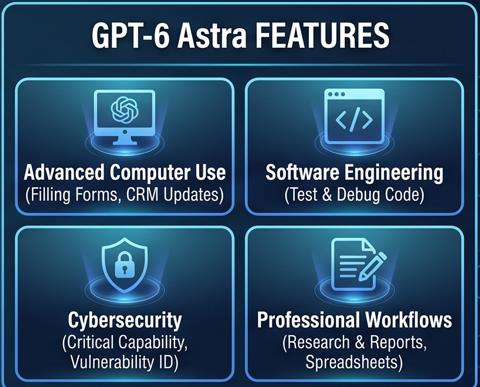
1. Advanced Computer Use
One of the most important changes in GPT-6 Astra is its ability to interact with computers.
According to OpenAI, Astra can perform tasks such as filling online forms, updating CRM records, organizing calendars, carrying out online research, creating websites, performing frontend quality checks, installing software, and troubleshooting problems visible on a user's screen.
This moves AI closer to the idea of a digital employee or autonomous software agent.
Instead of asking:
“How do I update 100 customer records?”
a user could potentially instruct Astra to carry out the workflow itself.
2. Stronger Coding and Software Engineering
GPT-6 Astra is also built for demanding software development tasks.
OpenAI positions it as a state-of-the-art model for software engineering, with the ability to write code, test software, troubleshoot issues, and work through complex development workflows.
For developers, this could mean AI taking on larger portions of the development lifecycle—from understanding a requirement to implementing, testing, and debugging the resulting software.
The OpenAI API identifies GPT-6 Astra as a model for complex reasoning, coding, computer use, research, and document creation.
3. Huge Context Window
Another significant technical feature is Astra's enormous context window.
OpenAI's developer documentation lists a 1,050,000-token context window, with a maximum output of 128,000 tokens.
A million-token context window is particularly valuable for tasks involving large codebases, extensive research material, long business documents, datasets, or complicated projects where the AI needs to keep a large amount of information available at once.
For developers building AI applications, this could reduce the need to repeatedly summarize or divide large projects into smaller pieces.
4. Better Professional Workflows
GPT-6 Astra isn't positioned only as a chatbot for everyday questions.
OpenAI says the model is specifically trained for professional environments and can produce documents, presentations, spreadsheets, and analyses while following existing templates and instructions.
That means a business could potentially use Astra for workflows involving:
- Research
- Reports
- Presentations
- Data analysis
- Spreadsheet work
- Customer management
- Software testing
- Administrative tasks
The important difference is that Astra is designed to combine reasoning with execution.
GPT-6 Astra Benchmark Performance
OpenAI reports extremely strong performance across several new and challenging evaluations.
Among the headline figures are:
- 98% on FrontierMath Tier 4
- 99.9% on ARC-AGI-3
- 100% on ExploitBench
OpenAI also says Astra achieved significant improvements in computer-use efficiency. In its OSWorld 2.0 latency simulations, Astra scored 72.6% at roughly 40 minutes per task, compared with 65.7% at roughly 75 minutes per task for GPT-5.6 Sol.
These figures should be viewed in context: benchmark performance does not automatically mean an AI will outperform humans at every real-world task. However, the results demonstrate how aggressively AI capabilities are progressing.
Is GPT-6 Astra the Beginning of AGI?
This is arguably the biggest question surrounding the launch.
OpenAI has described GPT-6 Astra as a step into the AGI era, with company leadership suggesting that future observers may look back on Astra as an important milestone toward artificial general intelligence.
However, AGI still has no universally accepted definition.
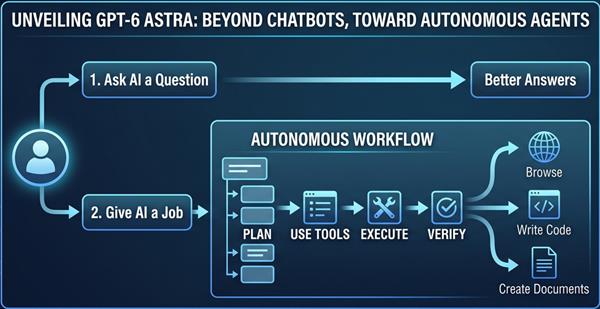
A more practical way to look at Astra is this: AI systems are increasingly moving from answering questions to completing goals.
Traditional chatbot:
User → Question → AI answer
Agentic AI:
User → Goal → AI plans → AI uses tools → AI completes task
GPT-6 Astra is clearly designed around the second model.
GPT-6 Astra and Cybersecurity
Astra's cybersecurity capabilities are another major part of the release.
OpenAI says GPT-6 Astra is its first model to reach the Critical level of cybersecurity capability under its Preparedness Framework. According to the company, Astra can identify previously unknown vulnerabilities and develop new exploitation techniques across well-protected systems when provided with the necessary tools and access.
That power creates both opportunities and risks.
On the defensive side, advanced AI could help security teams identify vulnerabilities faster, test systems, analyze threats, and strengthen infrastructure.
On the other hand, highly capable autonomous cybersecurity systems can be dangerous when used maliciously or when an agent behaves outside its intended scope.
That's why safety is one of the defining themes of the Astra launch.
OpenAI's New Safety Measures
OpenAI says Astra includes additional monitoring designed to identify situations where an agent may have misunderstood the user's instructions.
When such a case is detected, the interaction can be paused or stopped so that the user can review what happened.
OpenAI's safety documentation also says the company has strengthened protections around high-risk cyber capabilities, including stronger isolation, checkpoint encryption, monitoring of full model trajectories, and additional alignment evaluations.
This reflects a fundamental challenge with increasingly autonomous AI:
The more an AI can do independently, the more important it becomes to understand and control what it is doing.
GPT-6 Astra Availability
GPT-6 Astra is being introduced gradually.
OpenAI says the initial rollout is limited to a set of organizations, with broader availability planned for ChatGPT Plus, Pro, Business, and Enterprise users. The model is also being made available through the OpenAI API, Microsoft Azure, and Amazon Web Services' Bedrock platform.
For enterprise users, access can be controlled by administrators, and Astra is initially disabled by default in enterprise workspaces.
The exact availability of individual capabilities may also vary depending on the plan, deployment, and safety controls.
GPT-6 Astra API Pricing
For developers, OpenAI lists standard GPT-6 Astra API pricing at:
$10 per 1 million input tokens
$50 per 1 million output tokens
OpenAI also notes that prompts exceeding 272,000 input tokens are subject to higher pricing rates.
Developers can access the model using the API model name:
gpt-6-astra
The model supports reasoning effort levels ranging from low through max, according to OpenAI's developer documentation.
GPT-6 Astra vs Previous GPT Models
The biggest difference between GPT-6 Astra and earlier models isn't simply that Astra produces “better answers.”
The shift is toward doing the work.
Earlier GPT generations became increasingly powerful at:
- Understanding natural language
- Reasoning
- Writing
- Coding
- Summarizing information
- Generating creative content
GPT-6 Astra adds a much stronger emphasis on:
- Computer interaction
- Autonomous workflows
- Tool use
- Multi-step execution
- Professional productivity
- Software testing
- Research automation
This distinction could ultimately be more important than raw benchmark scores.
What Does GPT-6 Astra Mean for Users?
For everyday users, GPT-6 Astra could eventually change how we interact with software.
Imagine telling an AI:
“Find three suitable flights, compare the schedules, prepare a spreadsheet, and draft an itinerary.”
Or:
“Analyze these business documents, identify the most important trends, create a presentation, and summarize the recommendations.”
Instead of requiring the user to operate several applications manually, an agent could coordinate the entire workflow.
That is the larger promise of models such as Astra.
What Does GPT-6 Astra Mean for Developers?
For developers, Astra could accelerate the transition from chatbots to AI agents.
Developers can use the model for reasoning and coding while giving it access to tools and external systems through the Responses API. OpenAI has also added support for asynchronous tool calling for longer-running workflows.
This could enable applications that don't merely respond to users but actually:
plan → execute → verify → revise → deliver
That workflow has enormous potential in software development, customer support, operations, research, analytics, and automation.
The Biggest Concerns Around GPT-6 Astra
Greater capability also brings greater responsibility.
The same technologies that allow Astra to automate cybersecurity research, software development, and professional tasks can potentially be misused.
There is also a broader challenge around AI monitoring and interpretability. As models become more autonomous and their internal reasoning becomes more difficult to monitor, ensuring that the system remains within authorized boundaries becomes increasingly important.
The industry is therefore entering a period where AI progress isn't only about making models smarter.
It's also about making autonomous systems predictable, controllable, secure, and trustworthy.
Final Thoughts
GPT-6 Astra represents a major shift in OpenAI's strategy.
The model isn't simply being presented as a smarter chatbot. It is being built as an AI system capable of reasoning about a goal, interacting with computers, using tools, handling complex workflows, and producing finished work.
Its benchmark results, million-token context window, advanced coding capabilities, computer-use functionality, and cybersecurity performance make it one of the most significant AI launches of 2026.
But perhaps the most important development is conceptual.
The AI industry is moving from:
“Ask AI a question.”
to:
“Give AI a job.”
GPT-6 Astra is one of the clearest examples yet of that transition.
For users and businesses, the next phase of AI may not be about having a better chatbot on the screen.
It may be about having an AI teammate that can actually do the work.
 Tutorial
What Is Artificial Intelligence? 10 Real-World Engineering Examples Explained
 Tutorial
Building Your Own Enterprise AI Assistant: Architecture Patterns with RAG and Tool Calling
 Tutorial
Building an Enterprise RAG Application in C# with Google Gemini and SQL Server 2025 Vector Engine
 Tutorial
How to Build RAG in C# with Google Gemini API and Semantic Kernel
Comments

|
|
| Follow up comments |
| {{e.Name}} {{e.Comments}} |
{{e.days}} | |
|
|
||
|
|
||
| {{r.Name}} {{r.Comments}} |
{{r.days}} | |
|
|
||